Last updated: August 2026. Next scheduled update: February 2027. All figures are attributed to their original source and dated, because in this market a number without a date is a guess.
As of August 2026, ChatGPT is the most used standalone AI assistant in the world, with 1 billion weekly active users, but it no longer dominates the way it did. Google's Gemini app reached 950 million monthly users, Meta AI reports 1.2 billion monthly users inside its apps, and Google's AI Overviews reach roughly 2.5 billion people through ordinary search results. ChatGPT's share of global AI chatbot web traffic has fallen from about 87% in early 2025 to about 54% in mid 2026, not because it shrank, but because everyone else grew faster.
That is the one-paragraph answer. The longer answer depends on which lens you use, and on where in the world you look. This page covers all of it: how market share is measured, the current standings, the three-year trend, and the regional markets where the rankings look nothing like the global headline.
How is AI market share actually measured?
There is no single AI market share number, because the major platforms report different metrics and third parties measure different things. Three lenses matter, and they produce different leaders.
1. Active users (what the platforms announce). OpenAI reports weekly active users, Google and Meta report monthly active users, and a weekly number is a much stricter bar than a monthly one. These figures are self-reported at earnings calls and keynotes, so they arrive on the company's schedule and in the company's preferred framing.
2. Web traffic share (what independent trackers measure). Similarweb and similar services estimate visits to each assistant's website and app. This is the closest thing to a neutral, continuously updated scoreboard, but it undercounts assistants that live inside other products, such as Meta AI inside WhatsApp or Copilot inside Windows and Office.
3. Enterprise API spend (what businesses pay for). Surveys like Menlo Ventures' enterprise reports track which model providers companies build on. This lens produces a completely different leader than the consumer lenses do.
Any article that quotes one "AI market share" percentage without saying which lens it comes from is comparing apples to nothing. The sections below keep the lenses separate.
Who leads AI in 2026? The headline numbers
The table below shows the most recent official or well-sourced figure for each major platform, with the metric and date attached. These are different metrics, so read them as reach indicators, not as slices of one pie.
| Platform | Latest reach figure | Metric | Source and date |
|---|---|---|---|
| ChatGPT (OpenAI) | 1 billion | Weekly active users | OpenAI announcement, August 2026 |
| Meta AI | 1.2 billion (reports of 1.5 billion by mid year) | Monthly active users across Meta apps | Meta earnings, Q1 2026; subsequent reports |
| Gemini app (Google) | 950 million | Monthly active users | Alphabet Q2 2026 earnings, July 2026 |
| Google AI Overviews | ~2.5 billion | Monthly users of AI summaries in Search | Google, I/O May 2026 |
| Google AI Mode | 1 billion+ | Monthly active users | Google, I/O May 2026 |
| Microsoft Copilot | ~420 million | Monthly active users across all surfaces | Business of Apps estimate, 2026 |
| Doubao (ByteDance) | 382 million | Monthly active users, China | QuestMobile, May 2026 |
| Qwen (Alibaba) | 167 million | Monthly active users, China | QuestMobile, May 2026 |
| DeepSeek | 130 million | Monthly active users, China app | QuestMobile, May 2026 |
| Grok (xAI) | ~117 million | Monthly active users | Third-party estimates, mid 2026 |
| Perplexity | ~34 million | Monthly active users | Third-party estimates, 2026 |
| Claude (Anthropic) | Smaller consumer base, 9.2% of global chatbot web visits | Web traffic share | Similarweb via Momentic, May 2026 |
Three caveats worth keeping in mind. Meta AI's number is the softest of the giants: most of its usage happens ambiently inside WhatsApp, Instagram, and Facebook, and its estimated 40 million daily active users suggest occasional rather than habitual use. Copilot's figure spans every surface Microsoft can count, from Windows to Office. And Claude's consumer estimates vary so widely between trackers that its traffic share and enterprise position tell the truer story.
What is the AI chatbot market share by web traffic?
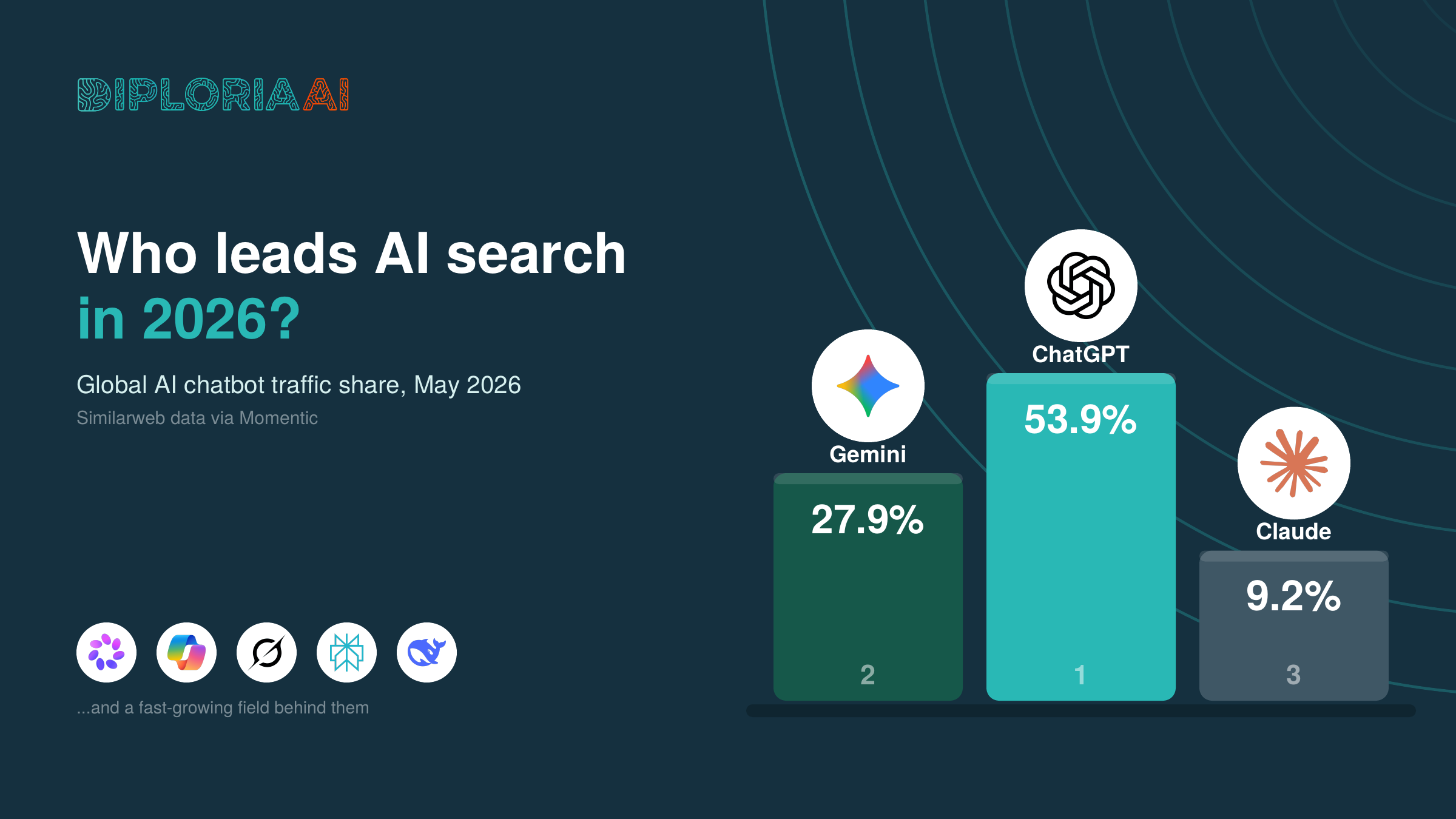
On the independent traffic lens, Similarweb data compiled by Momentic puts worldwide web-visit share across the seven largest assistants at, as of May 2026:
| Assistant | Global web-visit share | US web-visit share |
|---|---|---|
| ChatGPT | 53.9% | 58.3% |
| Gemini | 27.9% | 19.3% |
| Claude | 9.2% | 13.4% |
| Grok | not in top 3 globally | 3.4% |
| Microsoft Copilot | ~3% | 2.8% |
| Perplexity | ~2% | 1.6% |
| DeepSeek | ~1% | 1.2% |
The trend behind that snapshot is the real story. ChatGPT held roughly 87% of chatbot traffic in January 2025, about 68% in January 2026, and 53.9% by May 2026. Gemini went from 5.4% to nearly 28% over the same period. Claude's share roughly quadrupled in half a year, from just over 2% in December 2025 to around 9% by late May 2026, the fastest relative growth of any platform in the dataset, and its US share (13.4%) runs well ahead of its global share, reflecting a professional, English-market skew.
Other trackers using different methods report different splits: First Page Sage's user-based model still had ChatGPT above 60% with Copilot near 14% in April 2026, and Statcounter-style measures run higher again. The direction is the same everywhere: one dominant player becoming the largest of several, rather than the only game in town.
How has AI market share shifted from 2023 to 2026?
Three years of milestones, in one place:
2023: the monopoly year. ChatGPT reaches 100 million monthly users within two months of launch, the fastest consumer app adoption recorded at the time. Google ships Bard in March. In the enterprise API market, OpenAI holds about 50% share (Menlo Ventures).
2024: the field forms. Bard becomes Gemini in February. Meta AI launches across Facebook, Instagram, and WhatsApp in April. ChatGPT passes 200 million weekly users in August and about 300 million by December. Enterprise LLM spend reaches $3.5 billion by November (Menlo Ventures).
2025: the breakaway year. January brings the DeepSeek moment: a free, open-weight Chinese model tops app charts in 140 markets within weeks. ChatGPT hits 400 million weekly users in February and 800 million by October. Gemini climbs from 400 million monthly users in May to 750 million by Q4, boosted by the Gemini 3 launch in November. Meta AI announces 1 billion monthly users in May. AI Overviews pass 2 billion monthly users in July. Enterprise spend explodes from $8.4 billion at mid year to roughly $37 billion for the full year, and Anthropic overtakes OpenAI as the enterprise API leader (Menlo Ventures).
2026 so far: a multipolar market. ChatGPT reaches 900 million weekly users in February and 1 billion in August, with more than 2.5 billion prompts per day. Gemini reaches 900 million monthly users at I/O in May and 950 million by the Q2 earnings call, with daily actives tripling year over year. Google discloses AI Mode passing 1 billion monthly users and AI Overviews reaching about 2.5 billion. Meta AI reports 1.2 billion monthly users in Q1. China's AI-native apps reach 499 million monthly users. No single company now controls the majority of every lens.
Which AI platforms lead in different regions?
The global figures hide how differently this market has developed by geography. Four contrasts stand out. For engine behavior outside English-speaking markets, see our guide to AI platforms in local and non-English markets.
United States: ChatGPT first, but the challengers are here
The US is more concentrated at the top than the world average: ChatGPT holds 58.3% of chatbot web visits (Similarweb, May 2026). It is also the market where Claude runs strongest, at 13.4% of visits, on the back of professional and developer adoption. Copilot's consumer web share is small (2.8%) despite its enterprise footprint, and Grok holds a niche but engaged base around X.
China: a parallel market of half a billion users
Mainland China runs on an entirely separate stack, since ChatGPT and Gemini are not officially available. QuestMobile's first-half 2026 report puts China's AI-native apps at 499 million monthly active users as of May 2026, up 85.4% year over year. ByteDance's Doubao leads decisively with 382 million monthly users, Alibaba's Qwen app is second at 167 million after growing more than fifty-fold in a year, and DeepSeek's app holds 130 million. Engagement is deep: users average 92.7 sessions per month. DeepSeek's larger global influence is now less about its consumer app and more about its open-weight models, which, together with other Chinese open models, account for a large share of token volume on model-routing platforms like OpenRouter.
India: the growth engine every platform is fighting for
India is ChatGPT's largest growth story: OpenAI reported 100 million weekly active users there in February 2026. It is also Meta AI's biggest market, with an estimated 142 million monthly users driven by WhatsApp. Google chose the US and India as the first two markets for AI Mode, which crossed 100 million monthly users across the pair before going global, and Google's partnership with Reliance Jio, announced in December 2025, bundles Gemini's paid tier free for Jio subscribers. No region better illustrates that the next billion AI users are being won outside the West.